Foundational
How you build it
- IGovernance is architectural, not operational.
- IIThe spawn chain is the authority chain.
- IIIThe ledger is ground truth.
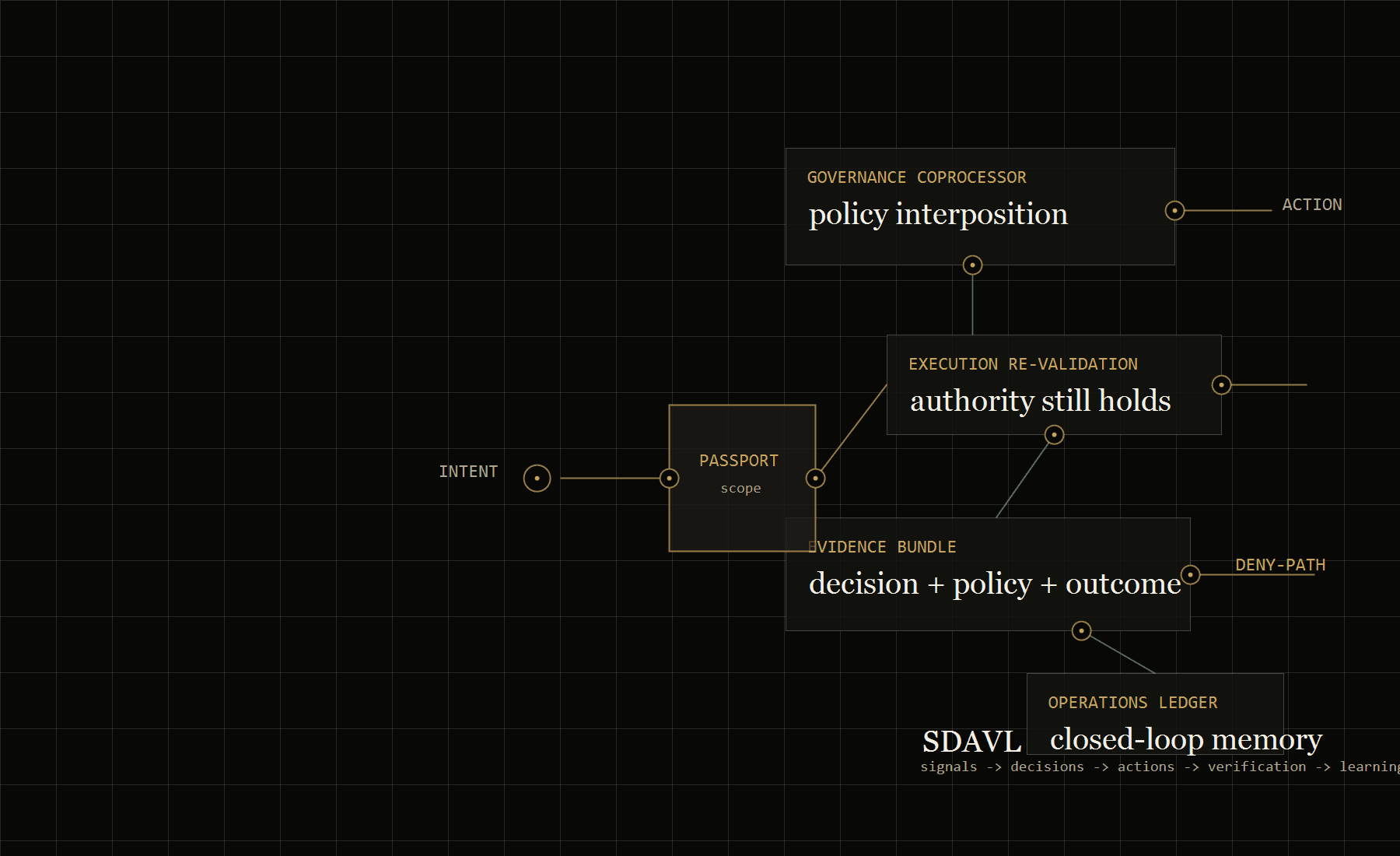
Agent Responsibility Engineering
ARE is the discipline of controlling autonomous systems at the execution boundary, where authority must be proven before an action is allowed to proceed.
Intelligence doesn't grant authority. Authority is earned through verifiable, governed policy.
Not prompts. Not filters. Not human checkpoint theatre. Governance as an engineering discipline.
Why ARE
Most AI governance is written as policy, review, monitoring, or documentation. Those are necessary, but they are often adjacent to the moment of failure.
ARE exists to govern the execution boundary: the place where a model result becomes a tool call, a workflow step, a record mutation, a notification, a payment, or a security decision.
Control premise 01
Capability is not authority.
Control premise 02
Approval is not execution control.
Control premise 03
Policy must be interposed, not merely documented.
Control premise 04
A system without a controller is not a governed system.
The Tenets
The tenets define the discipline before any implementation pattern does. They describe how ARE is built, operated, verified, and defended when autonomous systems are permitted to act.
The architecture must make authority visible before the system can make action permissible.
How you build it
How you run it
How you know it
How you hold the line
Core Primitives
These primitives make authority inspectable, enforceable, and reviewable without pretending that intent alone can control an autonomous system.
01
A verifiable authority token binding identity, scope, and delegated right to act.
02
Authority must still hold at execution, not only at approval or planning time.
03
A governed system must be able to refuse action, not merely observe it.
04
Every consequential decision should produce verifiable evidence, not just logs.
05
Immutable operational memory for decisions, actions, outcomes, and feedback.
06
Interposed control between intent and execution, independent of agent preference.
07
Signals to Decisions to Actions to Verification to Learning, closed as a governing cycle.
The ARE Difference
ARE does not discard prompts, filters, reviews, or observability. It places them inside a stricter question: can the system prove that this action is authorized now, under governed policy, with evidence?
They may shape intent, but they do not create enforceable authority at execution.
They often surround generation while the action boundary remains under-controlled.
It can remove unsafe text without proving the agent is allowed to perform the act.
Review theatre collapses when action is fast, delegated, repeated, or operationally hidden.
Observability describes what happened; governance must be able to interpose before it happens.
Principles matter, but principles without a controller do not govern production systems.
Execution Boundary
ARE is not a diagram of internal reasoning. It is a governing structure for the transition from proposed action to permitted execution.
A system proves authority before it acts, then carries the result back into the next decision.
Foreground control path
Public model / no implementation detail
Intent
01A request to act enters the governed boundary.
Control
02Policy is interposed before execution, not reviewed afterward.
Verdict
03The system must be able to refuse consequential action.
Action
04Capability moves only through proven authority.
Evidence
05The action path leaves an attributable operational record.
Closed-loop governance
Feedback is shown as a public principle, not an implementation recipe: execution changes the process model, and the next action meets an updated controller.
Accountability
The question is not whether an autonomous system can be blamed. The question is whether authority, control, and evidence were engineered before the system was allowed to act.
ARE separates attribution from accountability. The agent can be identified. The action can be governed. The organization remains responsible for the control structure it put into production.
01
Attribution
ARE gives every consequential action an identity path. That does not make the model morally responsible; it makes the action traceable.
02
Control
Policy, scope, denial, and evidence are architectural duties. If the execution boundary can be bypassed, the control design is accountable.
03
Governance
Leaders own the authority they delegate, the scopes they approve, and the evidence they can produce when autonomous systems act.
“A governed agent is accountable at the point it acts.”
Governance that cannot stop, shape, or evidence execution is not a control system. It is commentary after the fact.
STAMP Alignment
STAMP treats safety as an emergent property of a controlled system, not as a checklist of component failures. ARE carries that structure into agentic execution.
This is not metaphorical alignment. It is structural alignment: controller, process model, feedback, control actions, and a closed loop that can govern behavior under changing conditions.
Read the STAMP-ARE paperClosed-loop governing structure
Production Reality
Autonomous agents are moving from experiments into systems where actions have regulatory, financial, security, and reputational consequence.
Agents already operate near regulated workflows, enterprise systems, customer records, financial controls, and security boundaries.
The risk is not that agents speak incorrectly. The risk is that an apparently valid output becomes an unauthorized act.
ARE was shaped from production control problems: defensibility, auditability, enforcement, and the operational need to stop an action cleanly.
Public Surfaces
The discipline explains the control model. The foundation runs the first authority path. The client demo shows one governed workflow without exposing commercial internals.
Discipline
Tenets, STAMP/STPA paper, validation tiers, and public evidence boundaries.
Runnable
The S0/S1 open foundation for identity, scoped authority, policy checks, and proof basics.
Demo
A simple client entry point for selecting one action and seeing a proof summary.
Read Further / Contact
ARE is not a promise that agents will always behave. It is a discipline for making their authority explicit, enforceable, and defensible when they are asked to act.